One Man's Appliance Is Another Man's Dream Machine
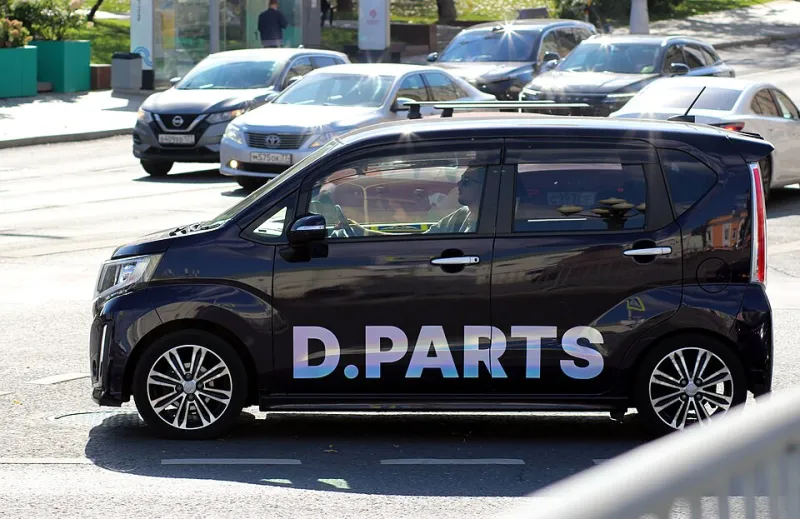
Photo: Retired electrician, CC0, via Wikimedia Commons
There's a particular kind of whiplash you get standing in a Honda dealership in Maebashi while an American customer photographs a mint-condition N-BOX like it's a Vermeer.
The sales manager, a Gunma lifer named Watanabe-san who has sold more Hondas than he can count, leans over and asks me the question that inspired this whole piece: "Why do Americans want the boring ones?"
He's not being rude. He's genuinely puzzled. To him, the N-BOX is what you buy when your kid joins the soccer club and you need something that parks itself in a two-meter space. It's the automotive equivalent of a rice cooker — reliable, sensible, and utterly unremarkable. Meanwhile, back in Ohio, his counterpart at a stateside dealership is watching customers pay $60,000 for crew-cab trucks with hoods the size of a pool table.
The Grass Is Always Greener (Or In This Case, Smaller)
Here's the irony at the heart of this story: both sides are envious of each other's "normal."
American enthusiasts discover Japanese kei vans through YouTube and immediately start fantasizing about importing one — right-hand drive, 660cc engine, and all. They see clever packaging, charm, and a break from the bloated SUV monoculture choking American parking lots. What they don't see is Watanabe-san's typical customer, who will trade in that same N-BOX after five years with all the emotion of replacing a water heater.
Meanwhile, plenty of Kita-Kanto drivers look at American cars — big, cheap, powerful, and gloriously unpretentious — with a certain wistfulness. A Tochigi-based Honda owner I'll call Sato-san put it perfectly over coffee: "I drove a rented Silverado in Texas once. It felt like driving my living room. Terrible fuel economy. Wonderful."
What We're Actually Shopping For
Spend enough time around dealers in Gunma and Tochigi, and a pattern emerges. The Americans who fly over or wire money from Portland and Austin aren't really buying transportation. They're buying a relationship with a car that their daily driver stopped providing.
Think about it. The average American new car now costs north of $48,000, weighs two tons, and is increasingly a touchscreen-wrapped appliance itself — just a bigger, more expensive one. The kei van and the Stepwagon represent the opposite bet: that a car can be modest, mechanical, honest, and still completely capable of hauling your family and your Costco haul (or your AEON run, as the case may be).
The locals, on the other hand, already had that. And like anyone who's had something their whole life, they've stopped noticing it. Ask a Takasaki mom about her Stepwagon and she'll tell you about the sliding doors and nothing else. Ask an Austin import nerd about the same van and you'll get a fifteen-minute monologue on the dual sunroofs and the third-row stow-and-go.
The Dealer's-Eye View
The team here at Honda4 Kita-Kanto has watched this dynamic play out dozens of times. A visitor from Seattle will spend an hour circling a used Freed, asking questions the local staff have genuinely never considered. Why the column shifter? Why is the spare tire under the front seat? Can the little 1.5-liter really handle mountain passes?
Yes — the locals answer, shrugging. It handles the Usui Pass every day. That's its job.
And that's the reveal, really. The thing that makes these cars special to us isn't some exotic quality. It's that they were designed, built, and used in exactly the environment we're admiring them in — narrow roads, tight parking, brutal winters, mountain passes. The 'ordinary' Honda of Kita-Kanto is ordinary the way a well-made tool is ordinary. It fits the hand that uses it here.
Maybe Envy Is the Point
So what does all this mutual coveting tell us? Maybe that no car is inherently boring — only familiar. The American lusting after a 660cc kei truck and the Gunma dad dreaming about a V8 are chasing the same thing: a vehicle that feels like it was made for their life, not the statistical average of everyone's.
The good news for the Americans is that the object of their affection is sitting right here in Kita-Kanto, priced like an appliance, documented like a museum piece, and ready to ship. The good news for the locals is that someone, somewhere, thinks their grocery-getter is a legend.
Both of them are right. That's the funny thing about cars — and the people who love them.
If you're one of the coveters, drop us a line. We'll take the photos, pop the hood, and show you why the 'boring' Hondas around here have more going on than meets the eye. Watanabe-san still doesn't get it. But he'll happily sell you one.