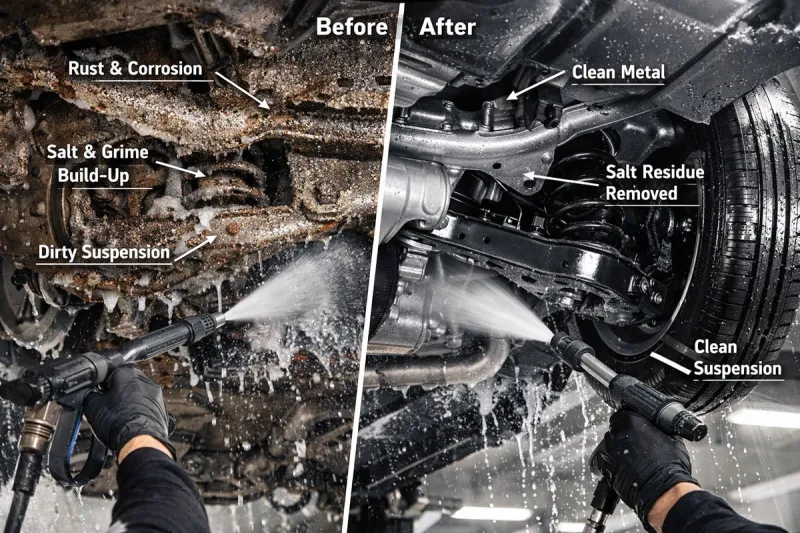
Your Neighbor's Salt-Rusted F-150 vs. a Shaken-Scrutinized Honda: An Honest Comparison
Photo: Internet Archive Book Images, No restrictions, via Wikimedia Commons
Let's be honest about what a $9,000 used car looks like in most of America. If you're shopping in the Rust Belt — Ohio, Michigan, western New York, pretty much anywhere the DOT spreads salt like confetti — you already know the drill. You crawl under the vehicle with a flashlight, poke at the frame rails with a screwdriver, and pray the rocker panels aren't held together by paint and optimism.
Now compare that with what we see every day on our lots in Gunma and Tochigi. A ten-year-old Honda Fit or Freed with a stamped paper trail, brake calipers that have been off the car within the last two years, and suspension bushings that were legally required to be in spec. It's not magic. It's the shaken.
What the Shaken Actually Is (And Why It Ruins Lazy Ownership)
Japan's shaken system is the automotive equivalent of a strict dentist. Every two years (three for brand-new cars), your vehicle has to pass a comprehensive government inspection covering brakes, steering, suspension, lights, exhaust emissions, and — this is the part Americans can't believe — visible corrosion that compromises structural integrity. Fail, and you fix it or park it.
There's no grumbling your way through it, no buddy with an OBD scanner to clear codes the night before. The inspection is done at licensed facilities, and the cost of bringing a failing car up to standard often exceeds the car's value. That creates a simple economic reality: owners either maintain their Hondas properly or they get rid of them early. Either way, the cars that stay on Japanese roads are the good ones.
The Salt Situation: Rice Belt vs. Rust Belt
Here's the part that surprises American buyers: Kita-Kanto gets real winters. Gunma and Tochigi see proper snow, and yes, they use road salt and calcium chloride. But there are two big differences.
First, the exposure window is shorter and the roads drain better. A car here might see thirty or forty salting events a season, not the months-long brine soak that Midwestern vehicles endure. Second — and this ties back to the shaken — corrosion isn't allowed to quietly accumulate for a decade. Structural rust gets flagged, and it gets fixed or the car exits the fleet.
Compare that with a domestic beater of the same age. The average ten-year-old truck in a snow state has been through five salt seasons since its last serious underbody attention, if it ever got any. Nobody forced the owner to do anything. That's the difference between a maintenance culture and a maintenance suggestion.
The Paper Trail You Never Get in the States
Ask an American seller for maintenance records and you'll get a shrug, a folder of gas station receipts, or a story about "an uncle who's a mechanic." Japanese used cars come with something better: a shaken history that documents inspections at fixed intervals, a maintenance booklet that dealers actually stamp, and auction sheets that disclose everything from paint scratches to previous repairs.
When we source a used Honda for an export customer, we can typically tell you when the brake fluid was last changed, whether the timing-related service was done, and what the inspector flagged at each biennial check. Try getting that level of documentation on a 2015 domestic sedan sold off a used lot in Toledo.
The Honest Caveats
We'd be doing you a disservice if we didn't mention the trade-offs. Right-hand drive is the obvious one — it's a genuine adjustment, and it's not for everyone. Import costs, shipping, and compliance paperwork add real money to the transaction, so the math works best on vehicles that are either hard to find in the US or in exceptional condition for their age. And parts availability, while better than people expect for popular models like the Acty, N-BOX, and Fit, isn't the same as walking into an AutoZone.
Our Verdict
A decade-old Honda from Gunma or Tochigi isn't automatically better than every American used car. But the system that produced it — mandatory biennial inspections, mandatory corrosion standards, a culture where skipping maintenance means losing the car — stacks the odds heavily in your favor. When your neighbor's ten-year-old domestic truck is flaking apart from five winters of brine, a shaken-documented Honda with a stamped service book starts looking less like an exotic import and more like the smarter bet.
Come argue with us about it. We've got the auction sheets to back it up.